Why Koreans Don’t Write Names in Red
Imagine writing a Korean friend’s name with a red pen.
You might think nothing of it.
But your friend suddenly looks uncomfortable and asks you to use another color.
Why?
In Korea, writing a living person’s name in red has traditionally been considered bad luck—and can even carry an association with death.
It is one of those small cultural details that international viewers may notice in K-Dramas without understanding why a character reacts so strongly.
But there is an important detail:
Red itself is not simply an “unlucky color” in Korean culture.
The real story is more interesting.
Quick Takeaway: Traditionally, Koreans have avoided writing the names of living people in red because of associations between red-written names, death, and misfortune. Today, many Koreans may not literally believe the superstition, but the practice can still feel uncomfortable or inappropriate.
Why Is Writing a Name in Red Bad Luck in Korea?
The basic rule is simple:
Avoid writing a living person’s name in red ink.
Traditionally, doing so could suggest that the person would die, encounter bad luck, or—in the strongest interpretation—that you wished something bad would happen to them.
That’s why something as harmless as choosing a red pen can create an awkward moment.
This doesn’t mean every Korean will be offended.
Belief varies by generation and individual.
But the association is familiar enough that using black or blue ink for someone’s name is the safer choice.

Where Did the Red-Name Superstition Come From?
This is where explanations online can become oversimplified.
A common explanation says that the names of deceased people were historically written in red, creating an association between a red-written name and death.
Korea.net, the South Korean government’s official information site, describes writing a person’s name in red as a traditional taboo associated with death and bad luck. Historical explanations commonly connect the practice with names of the deceased and rituals intended to keep harmful spirits away.
But it is better not to reduce the tradition to a single sentence like:
“Red means death in Korea.”
That isn’t accurate.
Red has carried several meanings in Korean culture, including meanings that are almost the opposite.
Is Red an Unlucky Color in Korea?
Not necessarily.
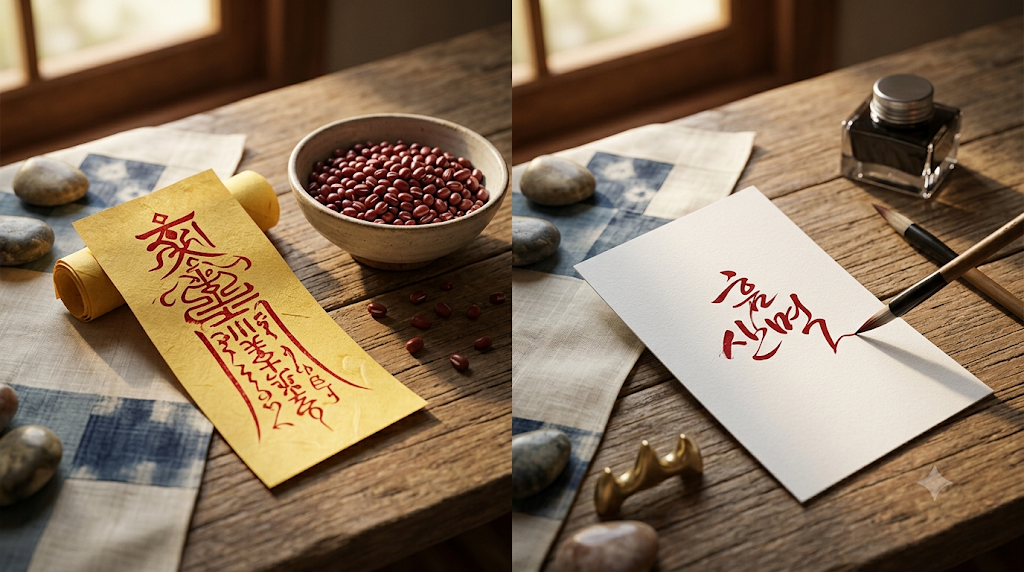
Traditional Korean culture also gave red a protective role.
Red could symbolize fire, vitality, and the power to drive away harmful spirits.
This is why red appears in traditional protective practices.
For example, Korean talismans known as bujeok (부적) have often used red pigment on yellow paper. Red was believed to possess a protective or purifying power against negative spiritual forces.
Red beans also appear in traditional customs connected with driving away harmful influences.
So we have an interesting situation:
Red can protect against evil.
Yet:
Writing a living person’s name in red can be taboo.
The meaning therefore depends on how the color is being used, not simply on the color itself.
Do Koreans Still Avoid Writing Names in Red?
Yes—but usually not in the dramatic way you might imagine.
Modern Koreans generally don’t walk around believing that accidentally writing someone’s name in red will cause that person to die.
Younger generations in particular tend to be less superstitious.
Still, cultural habits can survive even when literal belief fades.
Someone might say:
“I know nothing will happen, but it still feels weird.”
That’s an important distinction.
Think of other cultural superstitions around the world.
Someone might not genuinely believe that walking under a ladder will ruin their life, yet still instinctively avoid doing it.
The Korean red-name taboo can work similarly.
The supernatural fear may fade while the cultural discomfort remains.
What If You Accidentally Write a Korean Name in Red?
Don’t panic.
You haven’t placed a curse on anyone.
And you certainly don’t need to perform a ritual to undo it.
If you accidentally write someone’s name in red, simply use another color next time.
For international visitors, the useful takeaway isn’t:
“Never touch a red pen in Korea.”
It’s simply:
Use black or blue when writing someone’s name.
That avoids an unnecessary cultural misunderstanding.
Why This Matters When Watching K-Dramas
This small taboo is exactly the kind of cultural detail that can disappear in translation.
Imagine a scene where one character writes another person’s name in red.
A subtitle may show the conversation perfectly.
But it can’t automatically explain why the color matters.
For a Korean viewer, the visual itself may communicate:
death, bad luck, hostility, or something ominous.
For an international viewer, it may just look like a red pen.
Understanding the superstition gives that scene an extra layer of meaning.
And this is why seemingly tiny details in K-Dramas can be worth investigating.
Sometimes the cultural meaning isn’t in the dialogue.
It’s sitting on the desk.
Is This the Same as Using a Red Personal Stamp?
No.
This is another reason the idea that “red is forbidden” is misleading.
Traditional Korean personal seals, or dojang (도장), commonly use red ink.
The seal functions as a signature or mark of identification, and red impressions are completely normal.
So:
Red pen + living person’s written name → traditionally uncomfortable
Red seal impression → normal
Context changes the meaning.
More Korean Superstitions You May Notice in K-Dramas
The red-name taboo is only one example.
Korean culture has many traditional beliefs that can appear unexpectedly in dramas:
- the number four being considered unlucky,
- avoiding cutting fingernails at night,
- pig dreams being associated with wealth,
- giving shoes to a partner supposedly helping them “run away,”
- and certain foods being considered lucky or unlucky before exams.
Explore more: 10 Korean Superstitions You Still See in K-Dramas
[INTERNAL LINK — Link the title above to your “10 Korean Superstitions You Still See in K-Dramas” article, then delete this instruction.]
Once you recognize these references, some K-Drama scenes become much easier to understand.
Frequently Asked Questions
Why don’t Koreans write names in red?
Traditionally, writing the name of a living person in red has been associated with death, misfortune, or wishing harm upon that person. Although literal belief has declined, many Koreans still recognize the taboo.
Does writing someone’s name in red mean you want them to die?
That is one traditional interpretation, which is why deliberately doing it can feel inappropriate. In modern life, however, an accidental use of a red pen is unlikely to be treated so dramatically.
Is red an unlucky color in Korea?
No. Red has multiple meanings in Korean culture. Traditionally, it could also represent vitality and protection and was used to repel harmful spiritual forces.
Can I use a red pen in Korea?
Of course. The taboo concerns writing a living person’s name in red, not using red pens in general.
Why are Korean stamps red if red names are taboo?
Personal seals traditionally use red ink and are culturally normal. The superstition concerns a person’s handwritten or written name in red, demonstrating how context changes the meaning of a color.
Final Thought
The Korean red-name superstition is easy to misunderstand.
The lesson isn’t that red is a bad color in Korea.
It isn’t.
Red has also represented protection, vitality, and the power to drive away harmful forces in Korean tradition.
The taboo is much more specific:
writing the name of a living person in red.
And even as literal belief in the superstition fades, that small cultural discomfort can remain.
So the next time you see someone react to a red-written name in a K-Drama, look beyond the pen.
The color may be telling part of the story.