Korean Pig Dream Meaning: Why It Means Money and Luck
What Does a Pig Dream Mean in Korea?
Imagine telling a Korean friend that you dreamed about a pig last night.
Instead of laughing, they might tell you:
“Go buy a lottery ticket.”
That’s because the Korean pig dream meaning is surprisingly positive. In Korean tradition, dreaming about a pig can symbolize money, wealth, prosperity, and good fortune.
It may sound strange if pigs have negative associations in your culture.
But in Korea, the pig has a very different symbolic history.
Quick Answer: A pig dream in Korea is traditionally considered a lucky dream, especially when the pig approaches you or appears healthy and abundant. Because pigs are associated with wealth, some Koreans even buy lottery tickets after having a particularly vivid pig dream.
Why Are Pig Dreams Lucky in Korea?
The connection starts with how pigs were traditionally viewed.
Historically, owning livestock represented real economic value. A healthy pig could provide food, reproduce quickly, and contribute to a household’s prosperity.
Pigs therefore became associated with fertility and abundance.
According to Korea’s National Folk Museum, pigs have long symbolized good fortune in Korean culture and were historically connected with sacred rituals as well as prosperity.
But there is also a fascinating linguistic connection.
The Korean word for money is:
돈 — don — money
A Sino-Korean reading associated with pig is also:
돈 — don
The characters and meanings are different, but the similar sound helped strengthen the cultural connection between pigs and money.
That makes a pig appearing in a dream particularly exciting.
If the pig symbolizes wealth, perhaps money is coming your way.
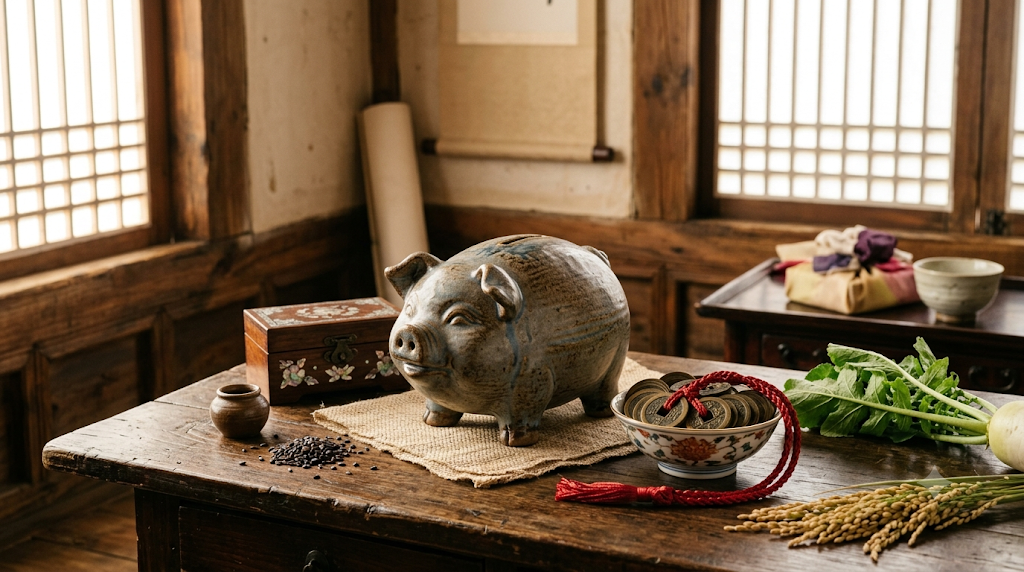
Why Do Koreans Buy Lottery Tickets After a Pig Dream?
This is probably the most entertaining part of the tradition.
Someone wakes up after having an unusually vivid dream involving a pig.
They tell their family or coworkers.
The response might be:
“You should buy a lottery ticket today.”
The logic is straightforward.
Pig = wealth.
Pig dream = incoming wealth.
Lottery ticket = maybe this is your chance.
Korea.net specifically notes the Korean custom of buying lottery tickets after dreaming about pigs because the animal traditionally symbolizes riches and good fortune.
Of course, dreaming about a pig doesn’t actually improve your statistical chances of winning the lottery.
The cultural significance is what matters.
Even someone who doesn’t seriously believe in dream predictions might think:
“Well… it can’t hurt to buy one.”
That combination of superstition and playful optimism is one reason the tradition survives.
Does Every Pig Dream Mean Good Luck?
Not necessarily.
Traditional dream interpretation can depend on what happens in the dream.
A healthy pig approaching you can be interpreted positively.
Catching or receiving a pig may also suggest wealth or opportunity.
But a pig escaping from you can carry a very different meaning—the fortune may be leaving instead of arriving.
Traditional Korean folk interpretations aren’t a scientific system with one universal rulebook. Meanings can vary between families, generations, and sources.
So the useful cultural takeaway isn’t:
“Every pig dream guarantees money.”
It’s:
Pigs have such a strong association with prosperity in Korea that dreaming about one is commonly recognized as an auspicious sign.

Why Do Pigs Symbolize Wealth in Korean Culture?
Pig symbolism goes beyond dreams.
In traditional Korean culture, pigs have been associated with:
- wealth,
- fertility,
- abundance,
- good fortune,
- and prosperity.
Their ability to produce large litters naturally contributed to the symbolism of abundance.
The pig also appears in Korea’s twelve-animal zodiac and has a much longer cultural history than the modern lottery superstition.
One particularly striking example can be seen in traditional gosa (고사) ceremonies.
A gosa is a ritual traditionally performed to wish for good fortune, safety, or success—such as when starting a business or beginning an important project.
A pig’s head may be placed on the ceremonial table, sometimes with money inserted around it.
To international viewers, the image can be surprising.
Within the ritual context, however, the pig is connected with hopes for prosperity and success.
The National Folk Museum of Korea has documented these associations between pigs, wealth, fertility, ritual, and good fortune.
Pig Dreams in K-Dramas and Korean Conversations
This cultural background helps explain a scene that can easily get lost in subtitles.
Imagine a K-Drama character saying:
“I had a pig dream last night.”
Another character immediately responds:
“Buy a lottery ticket!”
International viewers might assume it’s just a joke.
A Korean viewer understands the cultural connection immediately:
pig → money → lucky dream → lottery
The same thing can happen in everyday conversation.
People don’t necessarily need to believe that dreams predict the future.
They only need to recognize the cultural meaning.
That’s an important distinction with many Korean superstitions.
Pig dreams are just one of many Korean superstitions you still see in K-Dramas, alongside unlucky numbers, red-written names, and unusual beliefs about food and gifts.
Related : 10 Korean Superstitions You Still See in K-Dramas.

Are Dreams Important in Korean Culture?
Pig dreams belong to a much larger Korean tradition of interpreting dreams.
Some dreams are considered gil-mong (길몽)—auspicious or lucky dreams.
Others may be interpreted as hyung-mong (흉몽)—ominous dreams.
One particularly interesting Korean tradition is taemong (태몽), or conception dreams.
These are vivid symbolic dreams associated with the arrival of a baby. Sometimes the pregnant woman has the dream, while in other cases a husband, parent, grandparent, or another relative may experience it.
Animals, fruit, jewels, dragons, and other powerful symbols can appear.
Taemong deserves its own explanation because it sits somewhere between folklore, dream interpretation, and family tradition.
Want to explore this tradition further? Learn what a Korean conception dream means, who can have a taemong, and why these dreams can become part of a family’s story.
For international viewers, the important point is that a dream mentioned in a K-Drama may occasionally carry more cultural meaning than the subtitles reveal.
Do Koreans Really Believe Pig Dreams Predict Money?
Some do.
Others don’t.
And many probably occupy the more interesting middle ground.
Someone might say:
“Of course I don’t believe a pig dream guarantees anything.”
Then buy a lottery ticket anyway.
That’s common with cultural superstition.
Literal belief can weaken while the habit, joke, or symbolic meaning survives.
The same pattern appears with other Korean beliefs.
Someone might not believe the number four can cause bad luck but still notice when an elevator uses F instead of 4.
Someone may not believe red ink can harm another person but still feel uncomfortable writing a living person’s name in red.
Internal Link: Link the phrase why the number 4 is unlucky in Korea to the article Why Is the Number 4 Unlucky in Korea?
Internal Link: Link the phrase why Koreans don’t write names in red to the article Why Koreans Don’t Write Names in Red.
Understanding these details is less about asking whether every Korean “believes” them and more about understanding why the reference makes cultural sense.
Frequently Asked Questions
What does dreaming about a pig mean in Korea?
A pig dream is traditionally considered a lucky dream in Korea. Pigs are associated with wealth, abundance, fertility, and good fortune.
Why do Koreans buy lottery tickets after dreaming about pigs?
Because pigs traditionally symbolize wealth, a vivid pig dream may be interpreted as a sign that financial luck is coming. Some people therefore buy a lottery ticket afterward.
Does every pig dream mean money?
No. Traditional interpretations can depend on what happens in the dream. For example, a pig approaching you may be interpreted differently from a pig running away.
What is a lucky dream called in Korean?
A lucky or auspicious dream can be called gil-mong (길몽).
Are pig dreams scientifically proven to predict good luck?
No. Dream interpretation is a cultural tradition and superstition, not a scientifically demonstrated way of predicting financial events.
Final Thought
For international viewers, a pig might not be the first animal that comes to mind when thinking about wealth.
In Korea, the association is much stronger.
Pigs have represented fertility, abundance, prosperity, and good fortune for generations.
That’s why waking up after a vivid pig dream can lead to an unusual piece of Korean advice:
Buy a lottery ticket.
You probably haven’t discovered tomorrow’s winning numbers.
But you have discovered something almost as interesting—
a small piece of Korean culture hidden inside a dream.