Why Is the Number 4 Unlucky in Korea?
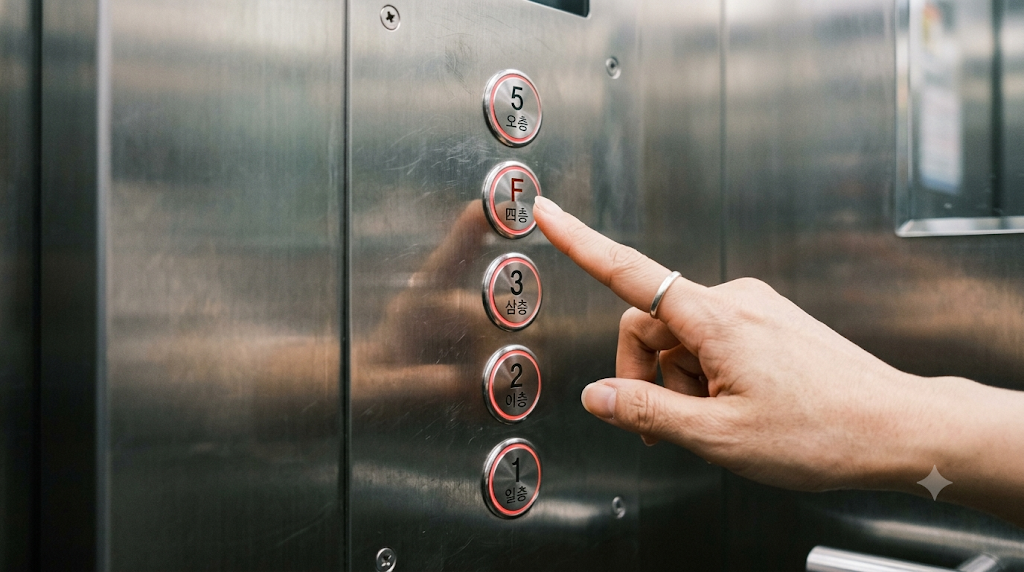
Step into an elevator in South Korea and you might notice something strange.
The buttons read:
1 – 2 – 3 – F – 5
Where did the fourth floor go?
No, the building isn’t missing a floor.
The answer comes from one of Korea’s best-known number superstitions.
In Korean, the Sino-Korean word for four sounds exactly like a word for death.
That similarity gave the number 4 an unlucky reputation—and explains why you may occasionally find an F button instead of 4 in Korean elevators.
Quick Takeaway: The Sino-Korean word for four is sa (사). A Sino-Korean word meaning death is also pronounced sa (사). Because of this similarity, the number 4 became associated with death and bad luck in Korea.
Why Does 4 Mean Bad Luck in Korea?
To understand the superstition, we need two Chinese characters.
The number four can be written:
四 — 사 (sa) — four
Death can be written:
死 — 사 (sa) — death
They are completely different characters with different meanings.
But in Korean, both are pronounced sa.
That homophone created an association between the number four and death.
It’s somewhat similar to how 13 developed an unlucky reputation in parts of Western culture—although the reason behind Korea’s number 4 superstition is linguistic.
The phenomenon isn’t unique to Korea, either. Similar associations with the number four exist in several East Asian cultures influenced by Chinese characters and vocabulary.
Why Do Korean Elevators Sometimes Use F Instead of 4?
This is probably the most visible example of the superstition.
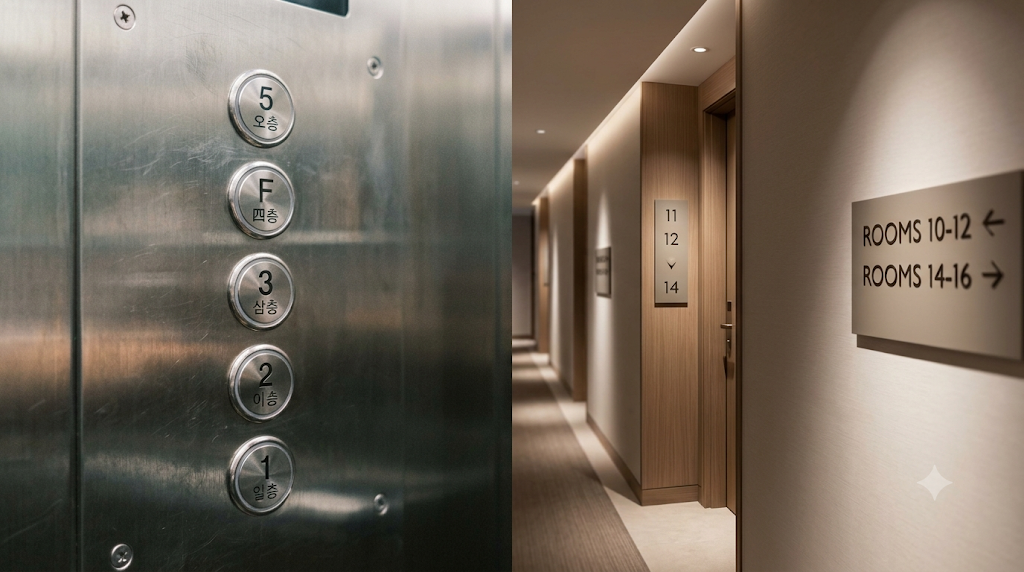
Some Korean buildings replace the 4 button in an elevator with:
F
The letter stands for fourth floor, while avoiding displaying the unlucky number itself.
Other buildings may simply use the number 4 normally.
So don’t expect every elevator in Seoul to look like:
1 – 2 – 3 – F – 5.
The practice varies by building.
Still, it remains common enough to surprise international visitors who encounter it for the first time.
And once you understand what sa means, the mysterious F suddenly makes sense.
Do Korean Hospitals Avoid the Number 4?
You may also encounter the superstition in places such as hospitals.
The association becomes especially understandable there.
If the number four already sounds like “death,” a hospital is one place where some patients might particularly dislike being assigned to a fourth floor or a room strongly associated with that number.
Historical and cultural accounts describe Korean buildings—including some hospitals—using F instead of 4 or otherwise avoiding the number.
But there’s an important point:
This is not a universal rule.
You can absolutely find Korean hospitals, hotels, apartments, and office buildings that use the number 4 normally.
It’s a superstition and cultural convention, not a law.
Are Koreans Actually Afraid of the Number 4?
Usually, “afraid” is too strong.
Many Koreans today understand the association without seriously believing that something terrible will happen because they entered Room 404 or pressed the fourth-floor button.
Younger generations in particular tend to be less superstitious.
But cultural habits can survive even when literal belief becomes weaker.
Think about the number 13.
Someone may happily say:
“I don’t believe 13 is unlucky.”
Yet a hotel might still avoid having a room numbered 13 because some guests dislike it.
The Korean number 4 can work in much the same way.
You don’t have to believe the superstition to recognize it.
Is Every Number Containing 4 Unlucky?
Not necessarily.
The basic superstition centers on 4 itself and its pronunciation, sa.
You may encounter stronger avoidance of the number in situations connected with rooms, floors, hospitals, or other places where the association with death feels more uncomfortable.
But modern Korea functions perfectly normally with the number four.
You’ll see it in:
dates,
prices,
addresses,
phone numbers,
sports,
public transportation,
and countless other everyday situations.
So it would be misleading to imagine Koreans constantly trying to eliminate every 4 from their lives.
The cultural association exists.
How seriously people take it is another matter.
Why This Detail Matters When Watching K-Dramas
This is exactly the kind of detail that subtitles may not explain.
Imagine a suspenseful K-Drama scene.
A character enters an old hospital.
The elevator doors close.
The camera briefly shows:
1 – 2 – 3 – F – 5
For an international viewer, the F may simply look unusual.
A Korean viewer immediately understands why it is there.
Directors can also use familiar cultural associations with numbers, colors, food, dreams, or traditional beliefs to create a mood without explaining everything through dialogue.
Once you know the cultural background, you begin noticing these details.
And that’s one of the pleasures of understanding the culture behind K-Dramas.
Is 4 the Only Korean Superstition Like This?
Not at all.
Korean culture has many traditional beliefs that international viewers may encounter without realizing what they mean.
For example:
- writing a living person’s name in red can feel ominous,
- cutting your nails at night has an old supernatural warning attached to it,
- dreaming about pigs can symbolize wealth,
- sticky yeot can be given before an important exam for good luck,
- and giving shoes to a romantic partner supposedly helps them “run away.”
Explore more: 10 Korean Superstitions You Still See in K-Dramas
[INTERNAL LINK — Link the title above to your “10 Korean Superstitions You Still See in K-Dramas” article, then delete this instruction.]
Each superstition reveals a small piece of Korean language, history, or everyday culture.
Frequently Asked Questions
Why is the number 4 unlucky in Korea?
The Sino-Korean word for four is sa (사), which is pronounced the same way as a Sino-Korean word meaning death. This similarity led to an association between four, death, and bad luck.
Why do Korean elevators have an F button?
Some Korean buildings use F for the fourth floor instead of displaying the number 4 because of the traditional superstition surrounding four.
Do all Korean buildings skip the fourth floor?
No. Many buildings use the number 4 normally. Replacing 4 with F is a cultural practice found in some buildings, not a requirement.
Is the number 4 actually forbidden in Korea?
No. The number 4 is completely legal and appears throughout everyday Korean life. Its unlucky reputation is a superstition, not a formal restriction.
Is 4 like the number 13 in Western culture?
That’s a useful comparison. Both numbers have developed unlucky associations that can influence building and room numbering, even though many people don’t literally believe the numbers cause bad luck.
Final Thought
The mysterious F button in a Korean elevator tells a surprisingly large cultural story.
It begins with two completely different words:
四 — four
and
死 — death
Both became sa in Korean pronunciation.
From that small linguistic coincidence grew one of Korea’s most recognizable superstitions.
Most Koreans today aren’t terrified of pressing 4.
But the association remains familiar enough that some buildings still replace it with a single letter:
F.
So the next time you spot one in Korea—or in the background of a K-Drama—you’ll know exactly why it’s there.