What Were Women’s Quarters in Joseon Korea?
A noblewoman hears visitors arriving.
But instead of walking into the room to greet them, she remains deeper inside the house.
Meanwhile, her husband receives the guests in another building.
Historical K-Dramas show scenes like this constantly.
To international viewers, the house may simply look enormous.
But the architecture itself can tell a story.
Understanding Joseon women’s quarters helps explain why elite men and women could live within the same family compound while occupying very different social spaces.
The key Korean word is anchae (안채).
And to understand the anchae, it helps to compare it with another important part of a traditional Korean home:
sarangchae (사랑채).
Quick Answer: In an elite traditional Korean hanok, the anchae was the inner domestic area associated particularly with women and family life, while the sarangchae was generally associated with the male household head, study, male guests, and more public activities. These spaces reflected broader Joseon ideas about gender and the separation of domestic and public life. However, real houses varied greatly, and “women’s quarters” should not be imagined as a single room where every Joseon woman was permanently confined.
What Does Anchae Mean?
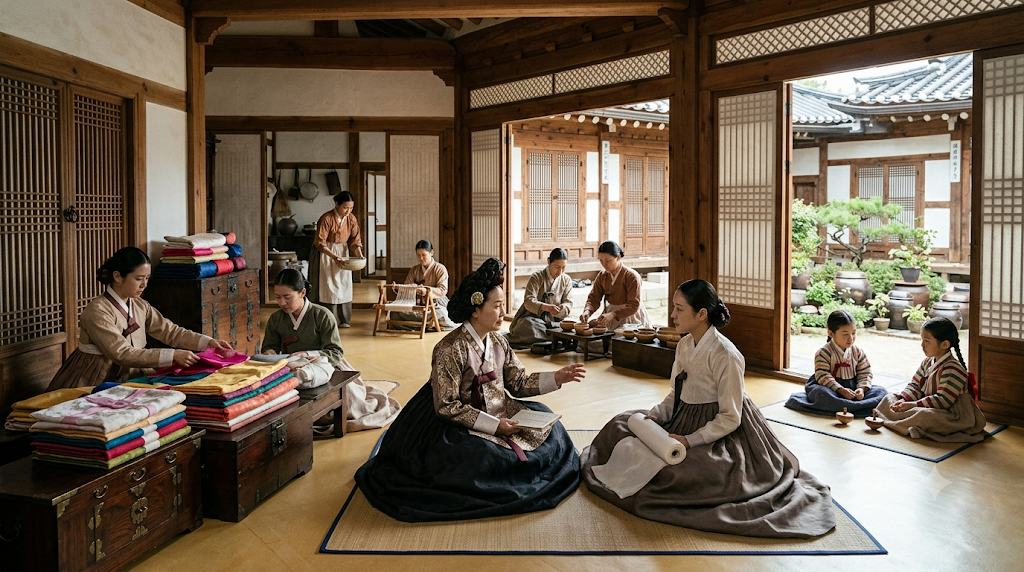
The anchae (안채) was the inner or main domestic section of a traditional Korean house.
The word can be understood through:
an (안) — inside or inner
chae (채) — a building or section of a building
In elite households, the anchae was particularly associated with the women of the family.
This was where important parts of domestic life took place.
Depending on the household, activities could include:
cooking,
food preparation,
textile work,
childcare,
household management,
and everyday family life.
The principal woman of the household could exercise significant authority over domestic affairs from this space.
That is important.
Calling the anchae the “women’s quarters” can make international viewers imagine a passive space where women simply waited.
But the inner household was also a working social and economic environment.
A woman managing a large elite household could be responsible for people, food, clothing, family events, servants, and domestic resources.
So the anchae represented restriction in some contexts.
But it could also be a place of household authority.
What Was the Sarangchae?
The sarangchae (사랑채) was a section of an elite traditional house generally associated with the male household head.
It often served functions such as:
study,
reading,
receiving male visitors,
conversation,
and other activities connected with the household’s more public-facing life.
A scholar might keep books there.
Guests might be received there.
Political, intellectual, or family discussions could take place there.
This creates a useful contrast:
Anchae → inner domestic life
Sarangchae → male study and guest-facing life
But these should not be treated as rigid definitions that applied identically to every hanok.
House size, wealth, region, period, terrain, and family needs could all affect architecture.
A modest house could not reproduce the spatial organization of a huge yangban compound.
Still, in elite Joseon culture, the contrast between anchae and sarangchae gives international viewers an important clue about the relationship between architecture and gender.
Why Were Men’s and Women’s Spaces Separated?
The answer is connected to broader Neo-Confucian ideas about social order.
Joseon society increasingly emphasized distinctions between the roles of men and women.
One concept often discussed in this context is the separation between the inner and outer spheres of life.
Women were more closely associated with the household’s inner domestic world.
Men had greater access to public life, government, scholarship, official careers, and outside social relationships.
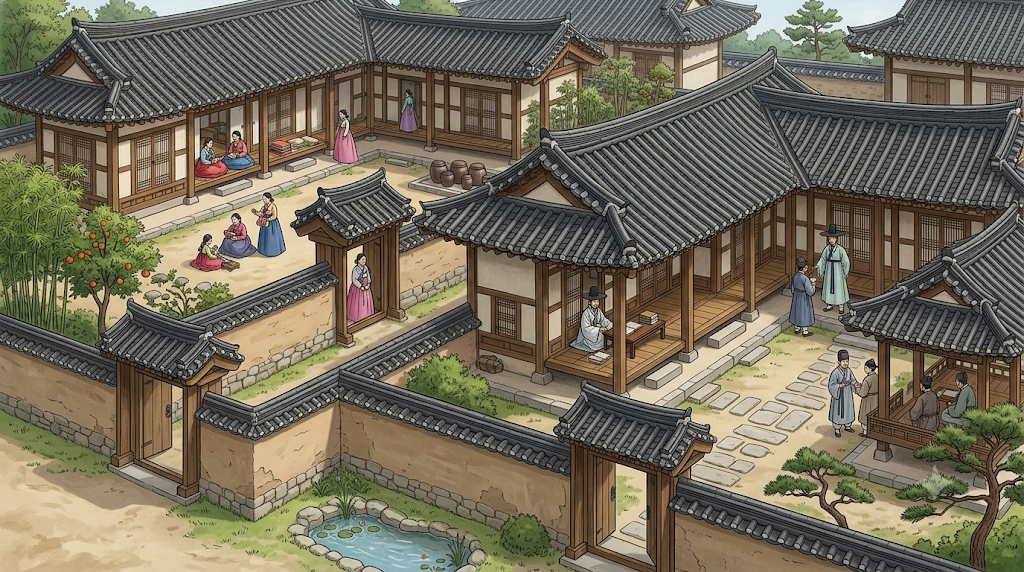
Architecture could reflect those expectations.
Walls mattered.
Courtyards mattered.
Gates mattered.
The position of buildings mattered.
A house could therefore do more than provide shelter.
It could organize social relationships.
This is why a historical K-Drama director can communicate a great deal without dialogue.
A woman standing behind an inner gate while men talk in the outer quarters is not simply an attractive composition.
The space itself may be telling you something about who is expected to belong where.
Did All Joseon Women Live in an Anchae?
No.
This is one of the most important qualifications.
When international viewers think of Joseon Korea, historical dramas often provide the visual reference.
But K-Dramas disproportionately focus on:
royal families,
wealthy officials,
yangban households,
scholars,
and other elites.
Those families could live in large compounds with multiple buildings and courtyards.
Most people did not live in enormous drama-ready residences.
Household architecture depended heavily on wealth and circumstances.
A poor farming family could not separate domestic life into multiple elegant buildings in the same way a wealthy elite household could.
Women also worked.
Depending on class and circumstances, women could participate in farming, household production, markets, food preparation, textile work, and other economic activities.
So Joseon women’s quarters should not be interpreted as:
“Every woman in Korea stayed inside the women’s building.”
It is more accurate to understand the concept within the context of elite domestic architecture and gender ideals.
This distinction becomes especially important once you understand what it meant to be yangban in Joseon Korea, because elite families had the resources and social expectations that made elaborate household organization more visible.
Were Women Literally Forbidden From Leaving the Anchae?
Not in the simplistic sense that every woman was permanently locked inside.
Real life was more complicated.
Women moved through household spaces.
They carried out domestic responsibilities.
They interacted with family members and servants.
They participated in religious, family, economic, and social activities depending on their circumstances.
Class also mattered enormously.
However, elite Neo-Confucian ideals increasingly emphasized female modesty and separation from unrelated men.
For women from prestigious households, avoiding unnecessary contact with male outsiders could be connected with ideas of respectable conduct.
This is where the physical structure of the house becomes socially useful.
Separate spaces could make it easier to control interaction between household women and male visitors.
So rather than imagining:
a prison
it is more accurate to think about:
a domestic environment organized around gendered expectations.
That distinction matters because historical dramas sometimes heighten the sense of confinement for storytelling.
The underlying social boundary was real.
But the everyday reality could be more flexible and complicated than the drama suggests.
Who Controlled the Anchae?
This is where the picture becomes more interesting.
Public restrictions on women did not necessarily mean women had no power inside the household.
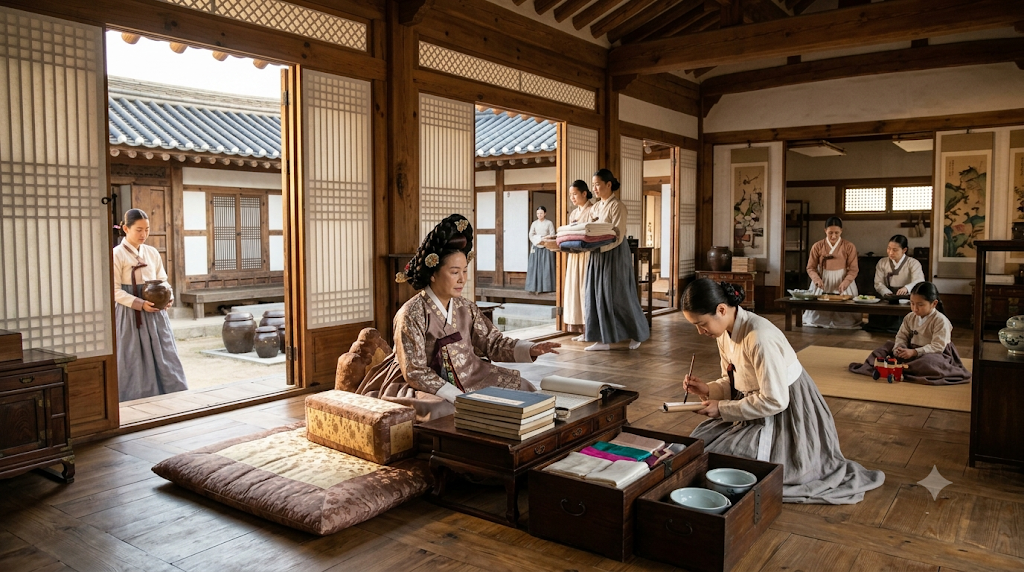
In an elite family, the senior woman could hold considerable domestic authority.
She might oversee:
household finances,
food supplies,
servants,
textile production,
family ceremonies,
children,
and relationships among women inside the household.
This gives us an important distinction between:
public authority
and
domestic authority.
Joseon society strongly limited women’s access to many formal public institutions.
But within a large household, an older or senior woman could exercise meaningful influence.
Historical K-Dramas often show this through characters such as:
the household matriarch,
the principal wife,
the mother-in-law,
or the grandmother.
She may rarely enter the male reception room.
Yet everyone inside the household knows her decisions matter.
Did Principal Wives and Concubines Share the Same Status?
No.
The women’s side of a household was not socially equal simply because everyone was female.
Hierarchy existed there too.
A man’s principal wife held a formally superior family position to his concubines.
That distinction could affect:
household authority,
family relationships,
children,
lineage,
and social status.
This is why the inner household in historical K-Dramas can become a complex political world of its own.
A conflict between a principal wife and concubine isn’t necessarily only about jealousy.
It may also involve rank within the family.
To understand why women within the same household could occupy very different positions, start with what a concubine was in Joseon Korea and how her status differed from that of the principal wife.
Did the Anchae Protect Women or Restrict Them?
In some ways, both interpretations can be useful—but neither tells the whole story alone.
From the perspective of Confucian social ideals, separating inner and outer spaces could be framed around:
proper conduct,
family order,
privacy,
and protection of household women from unrelated male visitors.
From a modern perspective, however, the same arrangement clearly reflects unequal access to public life.
Men could move more freely through political, educational, and social institutions.
Elite women faced stronger expectations surrounding domestic life and appropriate behavior.
This is why we should avoid two extremes.
The first is:
“The anchae was basically a prison.”
The second is:
“The separation had nothing to do with gender inequality.”
Both are too simple.
The architecture existed inside a society where gender roles were unequal.
But women could also exercise agency, authority, relationships, and economic influence within the domestic world.
Historical reality is more interesting than either stereotype.
Why Do Historical K-Dramas Use Doors and Courtyards So Often?
Once you understand the social meaning of hanok space, certain K-Drama shots become much more interesting.
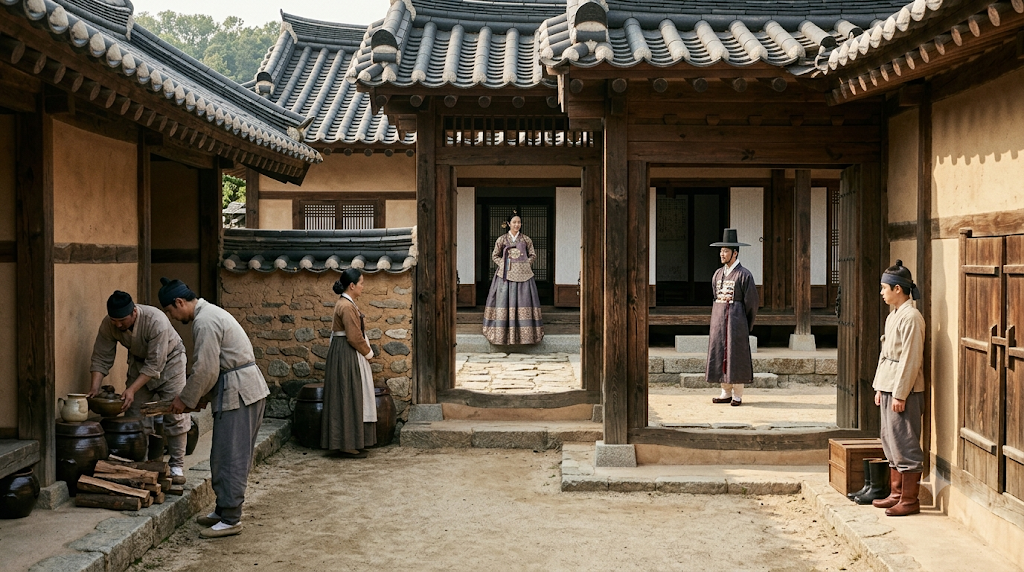
A woman stands behind a partially open door.
A man waits in the courtyard.
They can see each other.
But they don’t approach.
Or a noblewoman secretly crosses from the inner household toward a space associated with male visitors.
Nothing dramatic may happen physically.
Yet the scene feels dangerous.
Why?
Because the character may be crossing more than a courtyard.
She may be crossing a social boundary.
Doors, walls, gates, screens, and courtyards are therefore extremely useful visual tools in historical romance.
They can represent:
separation,
privacy,
reputation,
gender expectations,
and forbidden intimacy.
Why Do Women’s Quarters Matter in The Scandal?
This is especially relevant to Netflix’s The Scandal.
The story places desire and reputation inside an elite Joseon setting.
That makes the physical separation of men and women more than historical decoration.
A noblewoman’s access to public life is not the same as a nobleman’s.
Who she meets matters.
Where she meets him matters.
Whether other people can see them matters.
And crossing an expected social boundary can add meaning to an otherwise simple interaction.
Understanding Joseon women’s quarters therefore helps international viewers recognize why architecture itself can contribute to romantic and social tension.
For the larger context, our guide to the Joseon culture behind The Scandal explains how women’s roles, widowhood, concubines, birth status, yangban society, and reputation work together inside the drama’s historical setting.
What Did Women’s Quarters Look Like?
There was no single universal design.
Hanok architecture responded to many factors, including:
family wealth,
region,
climate,
available land,
household size,
and social position.
In larger elite compounds, the anchae could be separated from more public areas through courtyards, walls, gates, and the arrangement of surrounding buildings.
Privacy was important.
The inner area might be positioned deeper inside the compound, making it less directly accessible to outside visitors.
That physical arrangement reinforces the meaning of the word an—“inside.”
Visitors entering the household could therefore encounter different layers of space.
The deeper they moved into the compound, the more private the environment became.
For K-Drama viewers, this creates a useful visual rule:
The deeper inside the house a scene takes place, the more private and familial the space may be.
It isn’t an absolute rule.
But it is a useful detail to notice.
Is Sarangchae Related to the Korean Word for Love?
This is a fun language trap.
International viewers familiar with Korean may recognize:
sarang (사랑) = love
and wonder whether sarangchae means something like “love room.”
It doesn’t.
The sarang in sarangchae (사랑채) has a different historical linguistic origin and refers to the men’s section or reception/study area of the house.
So despite the identical modern spelling:
sarang = love
and
sarangchae = men’s quarters/reception area
should not be interpreted as the same concept.
This is a good example of why Korean words that look identical in romanization or Hangul can sometimes have different historical meanings.
Do Anchae and Sarangchae Still Exist in Korea?
Yes—as architectural and cultural terms.
Traditional hanok can still contain spaces identified as anchae and sarangchae.
Historic houses, cultural heritage sites, museums, and preserved traditional villages provide examples of these architectural arrangements.
But that doesn’t mean modern Korean families generally organize everyday life according to Joseon gender rules.
Modern South Korea is a contemporary society with very different legal systems, housing patterns, gender roles, and family structures.
Most Koreans live in apartments and modern houses rather than large elite hanok compounds.
Even when traditional architecture is preserved, the historical social rules associated with those spaces do not automatically continue unchanged.
So:
anchae and sarangchae remain part of Korean architectural vocabulary.
The strict Joseon social system behind them is historical context.
Frequently Asked Questions
What were the women’s quarters in Joseon Korea?
In elite traditional Korean homes, the inner domestic area associated particularly with women and family life was called the anchae (안채).
What does anchae mean?
Anchae literally combines the idea of “inside” with a building or section of a building. It refers to the inner domestic quarters of a traditional Korean home.
What is a sarangchae?
The sarangchae (사랑채) was generally the section associated with the male household head, study, receiving male guests, and more public-facing household activities.
Were Joseon women forced to stay inside the anchae?
It is too simplistic to say all Joseon women were permanently confined to an anchae. Women’s experiences varied greatly by class, household, period, and circumstance. However, elite gender ideals encouraged stronger separation between women and unrelated men.
Did poor Joseon families have separate women’s quarters?
Not necessarily. Elaborate separation of buildings required space and resources, so the large compounds seen in historical dramas are much more representative of wealthy and elite households than the entire population.
Do Korean homes still have women’s quarters today?
Modern Korean homes generally do not organize living space according to Joseon-era gender separation. Anchae and sarangchae remain important terms when discussing traditional hanok architecture.
Final Thought
The next time you watch a historical K-Drama, pay attention to where the characters are standing.
Not just what they’re saying.
Look at the doors.
The courtyard.
The gate.
Who receives the guests.
Who stays deeper inside the house.
And who crosses from one space into another.
In Joseon Korea, architecture could reflect the social expectations surrounding the people who lived inside it.
Understanding Joseon women’s quarters therefore adds another layer to the traditional hanok you see on screen.
The anchae wasn’t simply a beautiful background for noblewomen.
The sarangchae wasn’t simply another room for scholars.
Together, these spaces can reveal how Joseon society imagined the boundary between domestic and public life, women and men, privacy and reputation.
And in a historical K-Drama, crossing that boundary can sometimes tell you as much as the dialogue.