What Was a Yangban in Joseon Korea?
A nobleman walks into a room.
Everyone stands.
His family owns a large tiled-roof house. He studies Confucian classics, knows government officials, and seems to care deeply about who someone’s parents are.
A historical K-Drama subtitle may simply call him a “nobleman.”
But the Korean word you often hear is yangban (양반).
Understanding the Joseon yangban helps explain much more than social class.
It explains why education carries prestige, why family reputation can determine relationships, why marriage between families matters, and why losing social standing can be disastrous in Korean historical dramas.
And there is one misconception worth clearing up immediately:
Yangban did not simply mean “rich people.”
Quick Answer: The Joseon yangban were the elite social group associated especially with Confucian education, government office, family lineage, and social prestige. Wealth could support yangban status, but money alone did not fully define it. Yangban identity was tied to family background, education, official service, and recognition within local society.
What Does Yangban Mean?
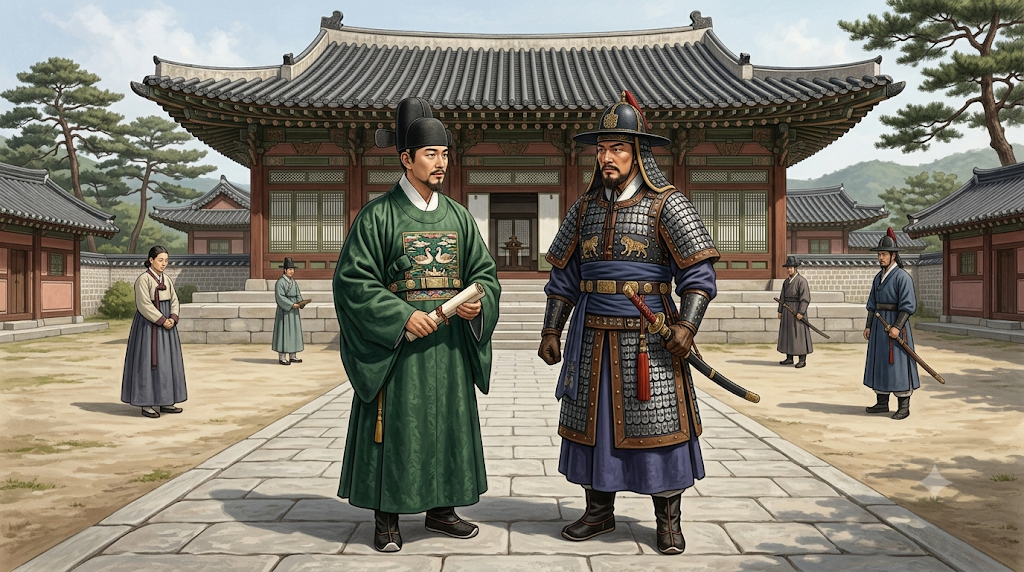
The word yangban (양반 / 兩班) literally refers to the “two orders” or “two groups.”
Originally, the term was connected to two categories of government officials:
Munban (문반 / 文班) — civil officials.
Muban (무반 / 武班) — military officials.
Together, these two groups formed the yangban.
Over time, however, the meaning became broader.
Yangban increasingly referred not only to officials currently serving in government but also to elite families associated with official status, Confucian scholarship, lineage, and social prestige.
This is why translating yangban simply as “nobleman” can be useful for subtitles but incomplete for understanding Korean history.
A European aristocrat and a Joseon yangban did not belong to identical social systems.
Yangban status developed within Korea’s own political, educational, familial, and Confucian institutions.
Were All Yangban Government Officials?
No.
This is an important distinction.
Government office was central to the historical origins and prestige of the yangban, but not every person identified with a yangban family was actively serving as an official.
Elite status could extend through families and generations.
A household might take pride in ancestors who passed state examinations or held important government positions.
Family genealogy could matter.
Local reputation could matter.
Confucian education could matter.
Connections to respected lineages could matter.
This helps explain a familiar K-Drama character:
the scholar from a prestigious family who doesn’t currently hold a powerful government position but is still treated as socially important.
His status may come partly from the family world surrounding him.
For the Joseon elite, the question wasn’t always simply:
“What job do you have?”
It could also be:
“What family do you come from?”
Why Was Education So Important to Yangban?
Education was one of the defining ideals of elite male culture.
Joseon was governed according to a Neo-Confucian political and ethical system.
For elite men, studying Confucian texts was not merely a private intellectual hobby.
Education could lead toward government service.
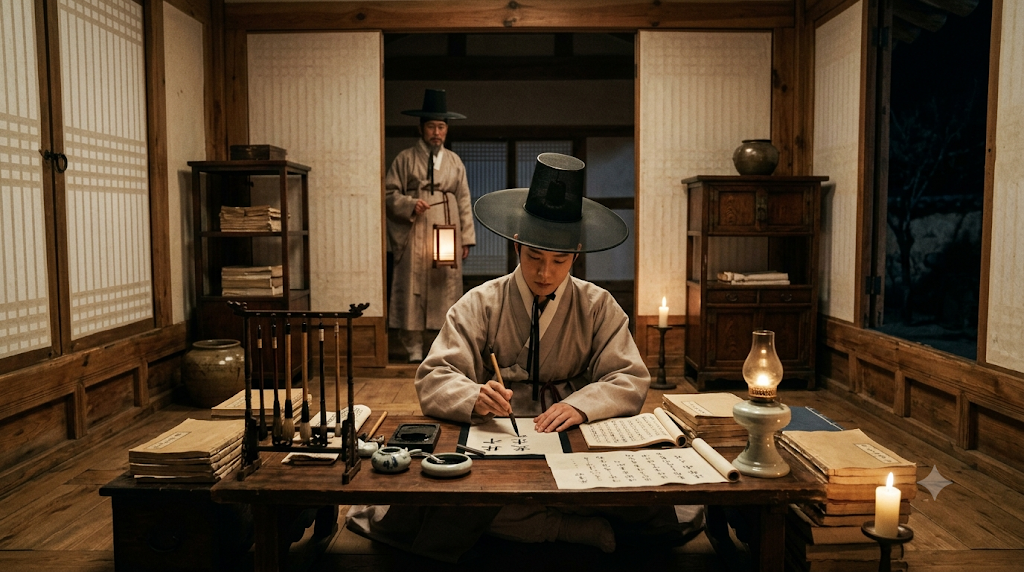
The state examination system, known broadly as gwageo (과거), offered routes into official careers.
Candidates studied subjects connected to Confucian classics, literary knowledge, and administrative culture.
Passing prestigious examinations could bring enormous honor to a family.
That’s why historical K-Dramas often show young men studying late into the night while their families anxiously wait for examination results.
To a modern viewer, it can look like:
“His parents really want him to get a good job.”
But the stakes could be much larger.
Success could enhance the reputation and prospects of an entire family.
Education, government service, and family prestige were deeply connected.
Were Yangban Simply the Richest People in Joseon?
Not necessarily.
Wealth and elite status often overlapped, but they weren’t exactly the same thing.
Yangban households could own land and have significant economic resources.
Those resources made it easier to devote time to education, maintain a large household, participate in rituals, and preserve elite lifestyles.
But wealth alone did not automatically reproduce every element of established yangban prestige.
A wealthy person without the appropriate family background, educational standing, or social recognition was not necessarily identical to a respected elite lineage.
At the same time, Joseon society wasn’t frozen.
Social and economic changes, particularly in later periods, complicated older status distinctions.
Some established elite families experienced economic decline.
Other families accumulated wealth and sought greater social recognition.
Claims to yangban identity could also expand.
So when a K-Drama portrays a wealthy merchant and a prestigious but financially struggling yangban family, that contrast isn’t necessarily a contradiction.
Money and status could overlap without being exactly the same thing.
Why Did Family Lineage Matter So Much?
For many elite families, identity extended far beyond the individual.
Ancestry mattered.
Genealogy mattered.
Marriage mattered.
Descendants mattered.
Confucian family culture placed strong emphasis on continuity between generations and proper ancestral rites.
Elite families could carefully maintain genealogical records known as jokbo (족보).
These records documented family descent and helped reinforce lineage identity.
This is one reason historical K-Dramas repeatedly ask questions that can seem intrusive to modern viewers:
Who is his father?
Which family is she from?
Who was his mother?
Is she from a respectable household?
These aren’t always background details.
They can tell the audience where a character fits inside the social order.
Family lineage becomes even easier to understand when you know what a concubine was in Joseon Korea, because children of the same father could face different social positions depending on their mother’s status.
Why Was Marriage So Important to Yangban Families?
Modern romance usually begins with two individuals.
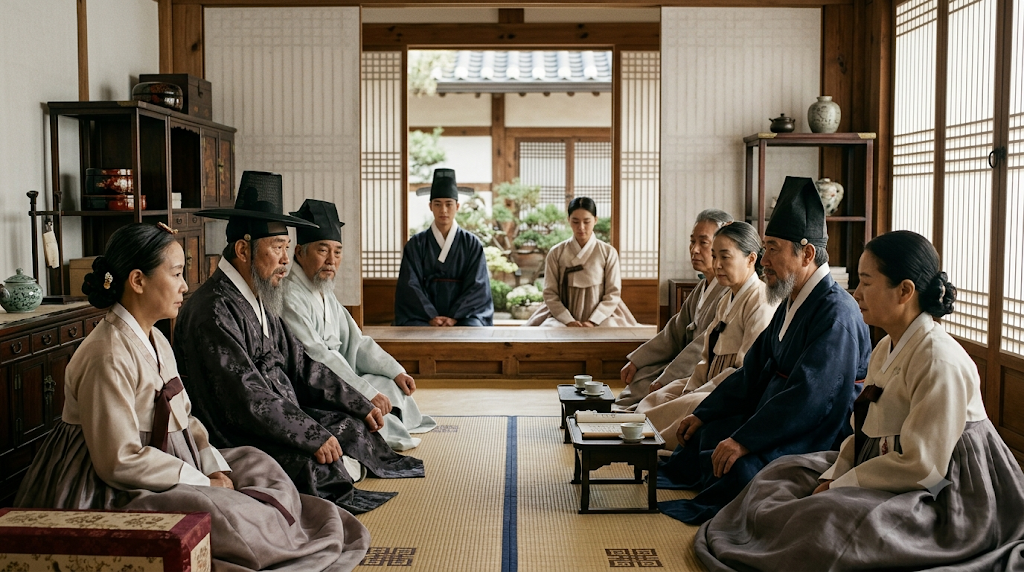
Elite Joseon marriage could involve two families.
A marriage affected:
family alliances,
social reputation,
descendants,
household continuity,
and lineage.
That meant choosing an appropriate marriage partner could be treated as a family matter rather than simply a personal preference.
This is why a common historical K-Drama plot works so well:
A young nobleman loves someone.
His parents object.
Modern viewers may immediately interpret the parents as villains standing between true love.
Sometimes the story certainly wants you to feel that way.
But historically, the family’s reasoning could involve much more than whether they personally liked the potential spouse.
They might care about:
family background, status, lineage, reputation, and suitability.
The romance is personal.
The marriage is social.
Did Yangban Women Have the Same Privileges as Yangban Men?
No.
Being born into an elite household gave a woman status, but it did not give her the same opportunities available to elite men.
A yangban man might pursue Confucian education, state examinations, government office, scholarship, and public social life.
Elite women’s lives were much more closely associated with household management, marriage, children, family rituals, and expectations of proper conduct.
Gender expectations became increasingly shaped by Neo-Confucian family norms.
That means elite status could create an interesting contradiction.
A noblewoman might belong to one of the most prestigious families in the country.
She could be educated and intelligent.
She could live in an impressive household.
Yet her choices could still be strongly restricted because she was a woman.
This is especially important when watching historical dramas centered on ambitious noblewomen.
High social status did not erase gender inequality.
Those unequal expectations become particularly visible when you look at why widow remarriage became difficult in Joseon Korea, especially among elite families concerned with chastity, lineage, and reputation.
Where Did Yangban Women Spend Their Time?
Traditional elite homes could also reflect gender expectations through their physical layout.
The anchae (안채) was the inner domestic area associated particularly with women and family life.
The sarangchae (사랑채) was typically associated with the male head of the household, study, male guests, and more public activities.
Individual homes varied, and historical reality should not be reduced to the idea that every woman was permanently locked inside one room.
Still, the organization of elite domestic space can help international viewers understand how social roles became visible through architecture.
A noblewoman and nobleman might live inside the same family compound while occupying very different social worlds.
Our upcoming guide to women’s quarters in Joseon Korea explores why the anchae and sarangchae matter so much when interpreting women’s lives in historical K-Dramas.
Were All Joseon People Either Yangban or Commoners?
No.
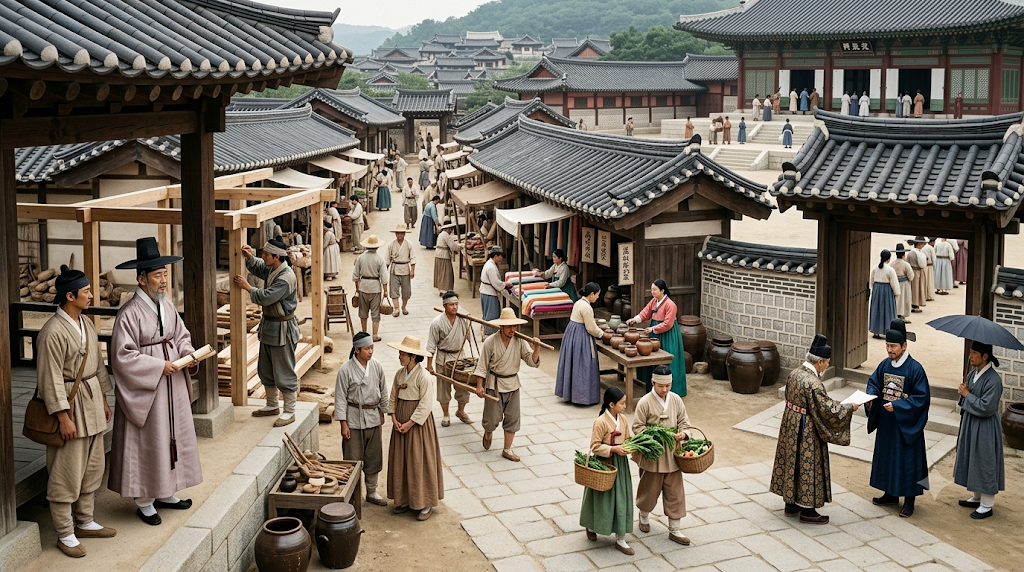
Joseon society was more complicated than a simple two-class system.
Broad descriptions often discuss several status groups, although categories and lived realities changed across the dynasty.
At the upper end were the yangban elite.
Below them, discussions of Joseon social structure may include groups such as jungin (중인), often associated with technical and specialized occupations.
The broad category of sangmin (상민) included much of the common population, including farmers and other ordinary people.
At the bottom were groups historically classified under cheonmin (천민) status.
But these categories should be treated carefully.
Joseon lasted more than 500 years.
Economic changes, government policies, occupations, regional differences, and changing social practices meant that real society was more complicated than a neat pyramid in a textbook.
For K-Drama viewers, the most useful point is simpler:
People did not enter a room as socially equal individuals.
Their background could influence how others spoke to them, treated them, married them, or evaluated their future.
Could Someone Become Yangban?
This question becomes more complicated depending on the period.
Yangban status was strongly connected to elite family background and official culture, but Joseon society changed considerably over the centuries.
The state examination system theoretically connected education and official achievement with elite status.
In practice, preparing for examinations required resources and education that strongly favored established families.
During later Joseon, economic and social changes made status boundaries more complicated.
Genealogical claims expanded.
Wealth could help families adopt elite lifestyles.
Local recognition could shift.
The meaning and social reach of yangban identity therefore changed over time.
This is another reason to avoid imagining Joseon society as a perfectly fixed caste system where nobody’s position ever changed.
Hierarchy was powerful.
But history was dynamic.
What Happened to Poor Yangban?
This is one of the most interesting contradictions in Joseon society.
Prestigious lineage did not guarantee permanent wealth.
A family could have respected ancestors but declining economic resources.
That could produce people who retained elite identity while struggling financially.
Historical dramas sometimes use this situation for comedy:
A proud scholar talks endlessly about his family name while his household has almost no money.
But the situation also reveals something important.
If yangban simply meant “rich person,” a poor yangban would make no sense.
Once you understand that status involved lineage, education, official tradition, and social recognition, the character becomes much easier to understand.
Prestige could survive longer than money.
Why Are Yangban So Important in Historical K-Dramas?
Because understanding yangban helps decode an enormous number of historical-drama conflicts.
When a character says:
“You cannot marry her.”
Ask about family status.
When someone insults another person’s parents or birth:
Think about lineage.
When an entire household celebrates an examination result:
Think about education and official prestige.
When a noblewoman risks scandal:
Think about family reputation.
When two sons of the same father are treated differently:
Think about maternal status and legitimacy.
When a scholar refuses to behave like a merchant even though he desperately needs money:
Think about elite identity.
The subtitles may translate yangban as “noble.”
But the story often expects Korean viewers to understand an entire social world behind that single word.
You can see several of these ideas working together in our guide to the Joseon culture behind The Scandal, where social status, widowhood, gender, family background, and reputation all shape the risks surrounding desire.
Does Yangban Still Exist in Korea Today?
Not as a legal social class.
Modern South Korea does not operate under the Joseon status system.
There is no modern legal privilege that makes someone yangban because of their ancestry.
However, the word hasn’t disappeared from Korean cultural memory.
People may discuss having yangban ancestors or refer to historically prominent family lineages.
The word can also appear in cultural, historical, humorous, or figurative contexts.
But this should not be confused with the social structure shown in historical K-Dramas.
A person in modern Seoul isn’t legally a yangban with special rights because an ancestor held office during Joseon.
Historical yangban status and modern Korean society are different things.
Frequently Asked Questions
What does yangban mean in Korean?
Yangban (양반 / 兩班) originally referred to the civil and military official groups of Joseon government. The term later became associated more broadly with Korea’s educated and socially prestigious elite families.
Were yangban nobles?
Calling yangban “nobles” is a convenient English shorthand, but it isn’t a perfect equivalent to European hereditary aristocracy. Yangban status was connected to Confucian education, government office, family lineage, and social recognition.
Were all yangban rich?
No. Many elite families possessed land and wealth, but economic status and social prestige were not identical. Some yangban families declined financially while retaining elite identity.
Could yangban women become government officials?
Elite women held high family status but generally did not have the same access as men to state examinations and official careers. Their social roles were much more closely connected with household and family responsibilities.
Why do yangban families care so much about marriage in K-Dramas?
Marriage could affect family alliances, lineage, descendants, and reputation. For an elite family, marriage was therefore much more than an individual romantic decision.
Do yangban still exist in South Korea?
Not as a legally recognized social class. Yangban is now primarily a historical and cultural concept, although some families trace ancestry to historical elite lineages.
Final Thought
The next time a historical K-Drama introduces someone from a prestigious yangban family, don’t simply translate that in your head as:
“He’s rich.”
Look for the larger picture.
His ancestors.
His education.
His family’s reputation.
His marriage prospects.
His relationship with government office.
And the expectations attached to his name.
Understanding the Joseon yangban reveals why characters can possess enormous social prestige without being royal—and why losing family reputation can feel almost as frightening as losing money.
Once you recognize that system, many historical K-Drama conflicts stop looking unnecessarily dramatic.
They start making cultural sense.