Why Did Joseon Widows Have Trouble Remarrying?
A husband dies.
Years later, his widow meets someone new.
For a modern audience, the question might be:
Will she fall in love again?
In a historical K-Drama set during the Joseon Dynasty, the question can be much more complicated.
Is she even supposed to?
Understanding Joseon widow remarriage helps explain why widowed women in Korean historical dramas can face enormous pressure over relationships that might seem completely ordinary to modern viewers.
The answer involves Confucian family ideals, female chastity, lineage, social status, and changes that developed over centuries of Joseon history.
And one important point should come first:
Widows did remarry in Joseon Korea.
The history is more complicated than simply saying remarriage was always illegal.
Quick Answer: Joseon widow remarriage became increasingly discouraged, particularly among elite families, as Neo-Confucian ideals emphasized a widow’s loyalty to her deceased husband. Laws and social restrictions also made remarriage costly for some families, while women who remained chaste could be publicly honored. But attitudes changed over time, and real Joseon widows did not all live according to the same ideal.
Was Widow Remarriage Actually Forbidden in Joseon Korea?
Not in the simple way historical dramas sometimes make it appear.
Joseon lasted from 1392 to 1910.
That’s more than five centuries.
Marriage customs, laws, and social expectations changed during that enormous span of time.
Widows did remarry, especially earlier in the dynasty.
The stronger restrictions associated with Joseon widow remarriage developed alongside the growing influence of Neo-Confucian family ideology.
One particularly important development came during the late 15th century.
Under King Seongjong, regulations strengthened the social consequences surrounding remarriage among elite women. Sons and grandsons of remarried women could face restrictions on eligibility for government office.
That matters because government service was extremely important to elite families.
The consequences therefore didn’t necessarily stop with the widow herself.
Her decision could affect the status and opportunities of her descendants.
This helps explain why remarriage could become a family issue rather than simply an individual’s romantic choice.
Why Did Confucianism Matter So Much?
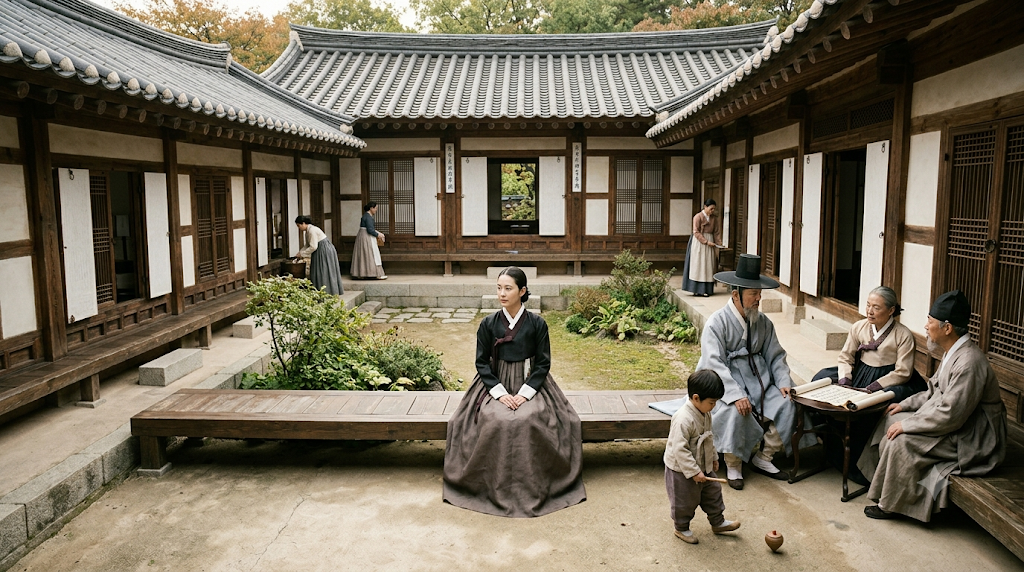
Joseon adopted Neo-Confucianism as a central ideological framework for government, education, family organization, and social ethics.
Within this system, the family was not viewed simply as a private collection of individuals.
Family relationships formed part of a larger moral and social order.
Husband and wife had prescribed roles.
Parents and children had prescribed obligations.
Ancestors mattered.
Lineage mattered.
And proper behavior within the family could be treated as a reflection of moral character.
For women, ideals increasingly emphasized virtues such as obedience, chastity, household responsibility, and devotion to family.
A widow who remained loyal to her deceased husband could therefore be presented as morally admirable.
Over time, the ideal became increasingly powerful.
But there is an important distinction:
An ideal tells us what society praised—not necessarily what every person actually did.
Real women lived under different economic circumstances, belonged to different social classes, and made different choices.
That’s why Korean history becomes misleading if we imagine every Joseon widow behaving exactly like the virtuous widow portrayed in official moral texts.
What Did “Chaste Widow” Mean?
One concept that international viewers may encounter when exploring Joseon history is the ideal of the chaste widow.
In Korean, discussions of female chastity are often associated with yeolnyeo (열녀 / 烈女)—a woman celebrated for exceptional fidelity or virtue.
Remaining unmarried after a husband’s death could become evidence of devotion.
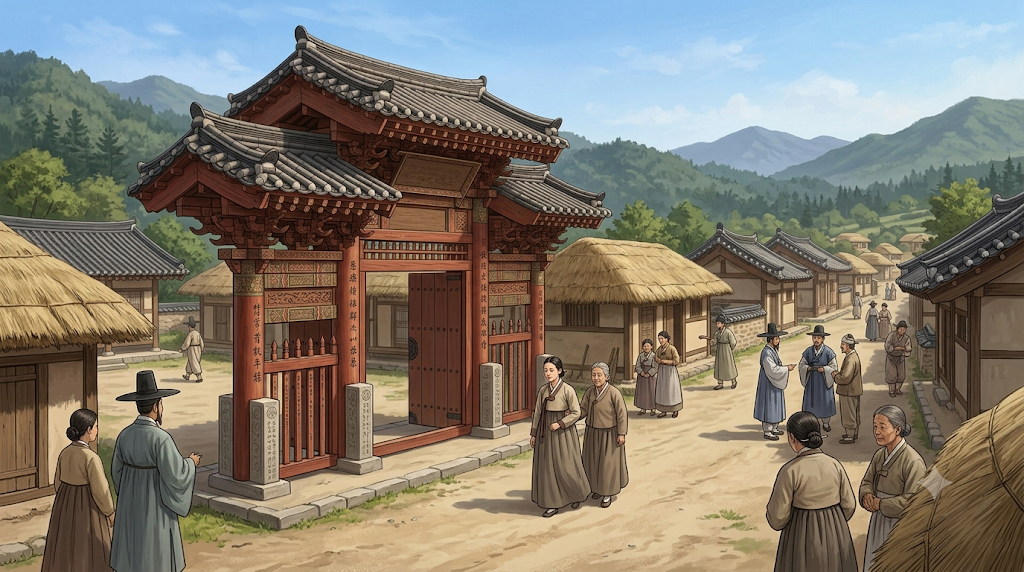
In especially celebrated cases, women regarded as models of virtue could receive official recognition.
Communities and the state could commemorate exemplary women through honors such as yeolnyeomun (열녀문)—commemorative gates or markers associated with women recognized for chastity and fidelity.
This tells us something important about Joseon society.
Widow chastity wasn’t only a private moral preference.
It could be publicly celebrated.
That created a powerful contrast.
A widow who remained faithful to her deceased husband could become a model of virtue.
A widow who remarried could face stigma, particularly within social groups that strongly valued Confucian family ideals.
Why Would a Family Oppose a Widow’s Remarriage?
Imagine the situation from the perspective of an elite Joseon household.
A marriage connected two families.
Children belonged within systems of lineage.
Ancestral rites mattered.
Social reputation mattered.
Now imagine a widow deciding to marry into another family.
From a modern perspective, that’s a personal decision.
Within the logic of an elite Confucian household, however, the decision could raise questions about:
- loyalty to the deceased husband,
- relationships with the husband’s family,
- children from the first marriage,
- family reputation,
- lineage,
- and the future status of descendants.
This is one reason Joseon marriage customs can look unusually restrictive to modern viewers.
Marriage wasn’t understood only through romantic partnership.
It also organized relationships between families and generations.
These expectations become especially useful when understanding the Joseon culture behind The Scandal, where widowhood, reputation, gender, and desire can dramatically change the stakes of a relationship.
What Happened If a Widow Had Children?
Children could make remarriage even more complicated.
A widow wasn’t necessarily making decisions only about herself.
Her children belonged to a family lineage, and the husband’s family could have a strong interest in their upbringing and status.
This is where Joseon family culture differs sharply from a modern idea of marriage centered primarily on the couple.
The household existed across generations.
The living family was connected to ancestors.
Sons carried particular importance within patrilineal family organization and ancestral rites.
A widow with children therefore occupied a complicated position.
She had lost her husband.
But she could remain deeply connected to his family and lineage through their children.
For an international viewer, this explains why a K-Drama widow may not simply pack her belongings and begin a new life somewhere else.
The social relationships surrounding her marriage could continue after her husband’s death.
Did These Rules Apply Equally to Men?
No.
This is one of the clearest gender inequalities behind the tradition.
A widower was not generally expected to demonstrate lifelong fidelity to his deceased wife in the same way a widow could be praised for remaining faithful to her husband.
Men could remarry.
Men could also have relationships with concubines within the social and legal structures of the period.
Women faced a different standard.
That’s why widow chastity needs to be understood as part of a broader gender hierarchy, rather than simply as a general Joseon belief that everyone should remain faithful to a deceased spouse.
The expectations were not symmetrical.
The contrast becomes even clearer when you understand what a concubine was in Joseon Korea and how differently male and female relationships could be structured.
Did Poorer Women Follow the Same Rules?
This is where social class becomes extremely important.
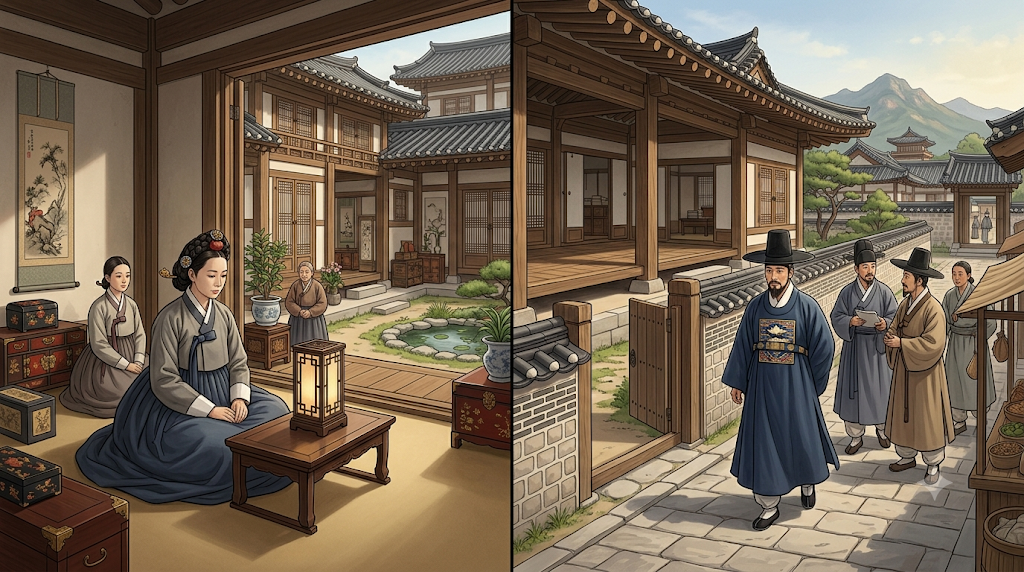
When we talk about strict Joseon family ideals, we’re often relying heavily on records concerning elites.
But women in Joseon Dynasty society did not all have the same lives.
A woman from an elite yangban family and a poor woman who needed to support herself faced very different economic realities.
For some widows, remaining unmarried might be financially difficult.
Daily survival could matter more than fulfilling an elite moral ideal.
This doesn’t mean Confucian values had no influence outside elite society.
They did.
But the gap between official ideal and everyday reality is essential.
Historical K-Dramas disproportionately show:
kings,
queens,
scholars,
officials,
wealthy households,
and yangban families.
That can make elite customs appear universal.
They weren’t necessarily experienced in exactly the same way by every Korean woman.
Understanding what it meant to be yangban in Joseon Korea will also help explain why family reputation and marriage rules could become particularly important among elite households.
Did Widow Remarriage Become More Restricted Over Time?
Broadly speaking, this is an important part of the story.
Early Joseon society inherited practices from the preceding Goryeo period, where remarriage was less heavily stigmatized.
As Joseon developed, Neo-Confucian family norms became more deeply embedded in law, ritual, and elite culture.
Patrilineal family organization strengthened.
Expectations surrounding female chastity became more pronounced.
By the later Joseon period, the image of the virtuous widow who remained loyal to one husband had become a powerful cultural ideal.
This is why we should avoid saying:
“Korean widows could never remarry.”
A better explanation is:
Joseon society increasingly discouraged widow remarriage and rewarded female chastity, especially within elite Confucian culture.
That distinction is historically much more useful.
Why Does Widowhood Matter So Much in Historical K-Dramas?
Now imagine a familiar scene.
A widowed noblewoman meets a man.
They develop feelings for each other.
Modern viewers might see a straightforward second-chance romance.
But the character may see something much more dangerous.
She may have to think about:
What will my family say?
What will his family say?
What happens to my reputation?
What about my deceased husband’s family?
What about my children?
Will people think I betrayed my husband?
Suddenly, a quiet conversation between two characters carries much more weight.
This is exactly why cultural context matters when watching a historical K-Drama.
The subtitles may translate every sentence correctly.
But they cannot always translate the social pressure surrounding the sentence.
Did All Joseon Widows Want to Remarry?
Of course not.
Another mistake would be to assume that every widow secretly wanted another marriage but was prevented from having one.
People are more complicated than that.
Some women may have genuinely valued ideals of fidelity.
Some may have wanted to remain within their husband’s household.
Some had children whose futures shaped their decisions.
Some faced economic pressures.
Others may have wanted to remarry despite social disapproval.
And many individual experiences were never recorded in enough detail for us to know.
This is why historical culture should not be reduced to:
“Joseon people believed X.”
A more accurate question is:
“What did Joseon society encourage, reward, discourage, or punish—and how might individuals have responded?”
That approach leaves room for both cultural structures and real human choices.
Was Widow Chastity Only About Romance?
No.
That’s another important distinction.
Modern viewers may interpret widow chastity entirely through romantic love:
“She loved her husband so much that she never loved anyone again.”
But the Joseon ideal was connected to much more than emotion.
It involved:
- moral virtue,
- family loyalty,
- social reputation,
- Confucian gender expectations,
- lineage,
- and proper household order.
A widow could therefore be praised for fidelity regardless of whether modern viewers would describe her situation as a romantic love story.
This difference matters when interpreting Korean historical dramas.
Modern dramas often translate historical social expectations into emotional narratives because emotion is easier for contemporary audiences to understand.
The historical system behind those emotions was often much broader.
Joseon Widow Remarriage vs. Modern Korea
This historical tradition should not be confused with modern Korean attitudes toward remarriage.
Modern South Korea operates under completely different legal and social structures.
Widows can remarry.
Divorced people can remarry.
Marriage is legally based on modern civil law rather than Joseon Neo-Confucian family rules.
Some cultural attitudes toward marriage, divorce, widowhood, and family reputation have changed gradually over generations, but Joseon widow remarriage restrictions are historical context—not rules governing Korean women today.
This distinction is especially important for international viewers.
Historical K-Dramas often make old customs feel emotionally immediate.
But a Joseon social expectation should never automatically be treated as a description of contemporary Korean life.
Frequently Asked Questions
Could widows remarry in Joseon Korea?
Yes. Widows did remarry, particularly earlier in the Joseon period. However, remarriage became increasingly discouraged under Neo-Confucian influence, and elite families could face social and institutional consequences.
Why was widow remarriage discouraged in Joseon?
Neo-Confucian ideals emphasized female chastity, loyalty to the deceased husband, family lineage, and proper household relationships. These values increasingly made remarriage socially undesirable, especially among elites.
Was widow remarriage illegal in Joseon?
It is misleading to describe widow remarriage as universally illegal throughout the entire Joseon Dynasty. Restrictions and social consequences changed over time, and widows did remarry.
What was a chaste widow in Joseon Korea?
A chaste widow was a woman praised for remaining faithful to her deceased husband, often by not remarrying. Exceptional examples could receive public or official recognition.
Did widowers have the same restrictions?
No. Men were not generally subjected to the same ideal of lifelong fidelity after a spouse’s death. This reflects the unequal gender expectations of Joseon society.
Do these traditions still apply in modern Korea?
No. Modern South Korean marriage and remarriage operate under contemporary civil law and very different social norms.
Final Thought
When a widow falls in love in a historical K-Drama, modern viewers may ask:
“Why doesn’t she just remarry?”
But that question assumes marriage is only about two people.
In Joseon Korea, it could involve much more.
A deceased husband.
His family.
Children.
Ancestors.
Lineage.
Reputation.
Social status.
And an increasingly powerful ideal that praised a woman for remaining faithful to one husband even after his death.
Understanding Joseon widow remarriage doesn’t mean assuming every widow accepted those expectations.
It means understanding the social rules surrounding her choices.
And once you see those rules, a seemingly simple historical K-Drama romance can become much easier to understand.